
Who has used IBC, and for what? Here are the main categories of use, with examples of each.
Press and media uses of IBC
IBC receives several specific press and media enquiries every week for data and comment on civilian casualties.
More innovative examples of data-oriented coverage include:
Website applications of IBC data to display regularly updated cumulative data on trends and distributions of deaths: Iraq violence, in figures (BBC 2005 & ongoing). Another noteworthy use is a BBC-designed map of bombings killing 10 civilians or more in post-invasion Baghdad combining IBC and BBC records: Baghdad: Mapping the violence (BBC Feb 2007)
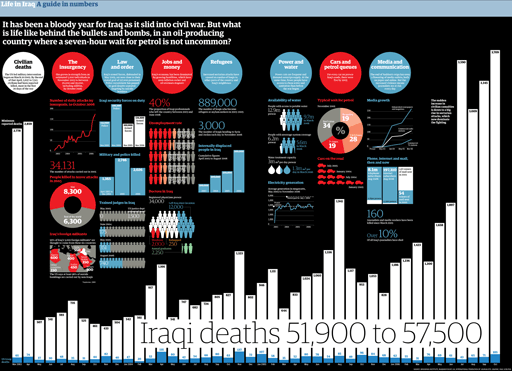
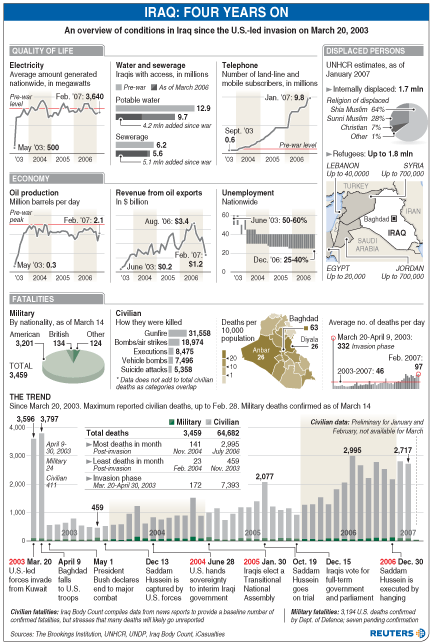
Graphic displays of trends based on IBC data have included:
The Guardian. Friday December 29th 2006,“Life in Iraq: a Guide in Numbers.”
Reuters. 16 Mar 2007. “Iraq: Four years on”
Lists of victims or victim categories to signal the pervasive impact on every sector of Iraqi society:
Daily Mirror 21 July 2005. Iraq, the Human Tragedy (lists every known occupation of victims).
Revealed: Iraq’s Civilian Death Toll. The Independent. Wednesday 20th July 2005. Full front page coverage in connection with the publication of IBC’s “Dossier of Civilian Casualties, 2003-2005.”
The following are examples of IBC-supplied data and commentary being used to assess official Pentagon data:
US quietly issues estimate of Iraqi civilian casualties. New York Times. October 30th 2005.
Counting Civilian Deaths in Iraq The Fact Checker. Washington Post. October 1st 2007.
Iraqi Civilian Deaths, Part II The Fact Checker (follow-up). Washington Post. October 19th 2007.
The Reality in Iraq? Depends on Who’s Counting The Public Editor. New York Times. October 7th 2007.
Examples of press and media comment and analysis involving IBC work:
But who’s counting: the tricky business of trying to tally civilian deaths in Afghanistan and Iraq. Macleans, Canada.
Counting Iraq’s Dead. Al Jazeera.net. May 11th 2007. TV news and comment item, including interview with IBC co-founder, John Sloboda.
A number of press and media articles focus on what can be known about civilian casualties in Iraq:
Many organizations keep track of Iraqi casualties — but no one knows the correct number for sure Associated Press, 16 Jan 2007
Some press and media coverage has focused on differences between IBC’s totals and other figures, including the much larger estimates published in the medical journal Lancet. See elsewhere on the site for IBC comment on the Lancet studies. This is one of the more balanced commentaries of this type:
Michael Thieren. Deaths in Iraq: how many, and why it matters. OpenDemocracy.net 18th October 2006